Chapter oneForm & Space
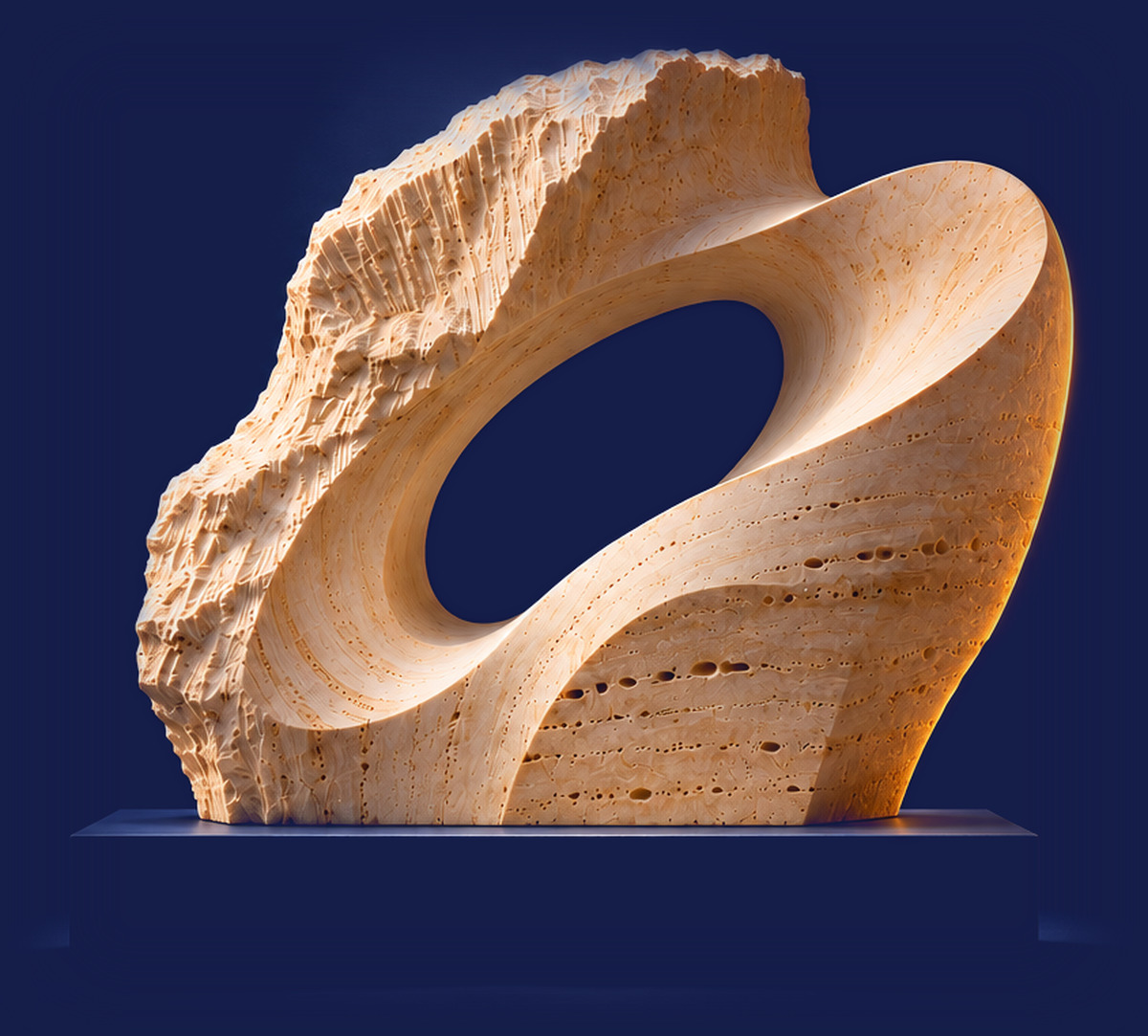
A sculpture is made of two things at once: the material you can touch, and the air around and through it. Sculptors call the solid part mass and the empty part void. A hollow, a gap between two limbs, or a hole bored clean through a block is not an absence — it is a shape the artist chose, with edges as deliberate as any carved surface.
Form also changes as you move. A figure that looks closed and guarded from the front may open completely from the side. That is why sculpture rewards walking around it: the work is not one image but a sequence of them, and the artist decided the order in which they arrive.
Try this
Stand in front of the sculpture at the top of this page and look only at the oval opening. Notice that the hole does more than lighten the stone — it frames the wall behind, pulls light into the middle of the mass, and splits one block into two sweeping arms. Cover the opening with your thumb and the whole piece turns into a lump.
↑ Back to the guide
Chapter twoMaterials
Every material sets its own rules. Marble is dense and even, so it holds a crisp edge and takes a polish that lets light sink a little way below the surface. Limestone and travertine are softer and full of pores, which gives a warmer, more open texture. Wood runs in grain, so it is strong along the fibre and fragile across it. Clay accepts a fingerprint instantly. Bronze, poured as liquid and set hard, can hold thin outstretched shapes that stone could never support.
Scale and weight matter just as much. A form that works at the size of a hand often fails at the size of a room, because the material has to carry its own load. Much of what looks like style is the artist negotiating with physics.
A concrete example
Travertine, the stone in the image above, forms in mineral springs and traps gas bubbles as it hardens. Those bubbles survive as small pits and channels running in roughly parallel bands. Look along the lower part of the sculpture and you can read those bands like the growth rings of the rock — the carver did not add that pattern, only revealed it.
↑ Back to the guide
Chapter threeCarving & Casting
There are two basic routes to a sculpture. Carving is subtractive: the artist removes material and can never put it back, so the work moves from rough to fine in careful stages — a point chisel to break away bulk, a toothed claw chisel to true the surface, flat chisels, rasps, then abrasives for polish. Casting is the opposite. The artist models a soft form in clay or wax, builds a mould around it, and fills that mould with molten metal, so the final object is a faithful copy of something that was once completely changeable.
The method usually leaves fingerprints on the result. Carved work tends to stay compact, because projecting parts are vulnerable. Cast work can reach, lean, and balance on a single point, since the metal arrives already strong.
How to spot the method
Look for tool marks. Parallel rows of short, angled furrows mean a claw chisel crossed the stone and was never polished away. On a bronze, look instead for a faint seam line where two halves of the mould met, and for a slightly duller patch underneath where a casting sprue was cut off and filed back.
↑ Back to the guide
Chapter fourLooking at Sculpture
Sculpture asks for a slower kind of attention than a picture, because it does not sit still. Light raking across a surface at a low angle exaggerates every ridge; light from directly above flattens the same surface into a pale sheet. Move a few steps and silhouettes merge or separate. None of this is incidental — placement, height, and lighting are part of the work, which is why the same piece can feel entirely different in two rooms.
A simple sequence helps. Find the silhouette first, then the balance of mass against void, then the surface and its marks, and only then the subject or title. Working from the whole to the detail keeps you looking at what is actually there instead of hunting for a story.
A three-minute exercise
Choose any sculpture and spend one minute at the front, one minute at roughly ninety degrees to it, and one minute close enough to see the surface texture. Afterwards, name the single view that felt most complete, and say why. Most people find it is not the view the photographs use — and noticing that gap is the whole skill.
↑ Back to the guide